
Bill Gates v. Planet Earth
Are plans for AI expansion behind co-founder's newfound heat tolerance?

Here’s some background for a Zoom talk I’ll be giving tomorrow (Wednesday) at noon Eastern standard time, or 10 a.m. Arizona time on how AI is hampering our planet’s ability to deal with climate change. Please see below for more details and the link to sign up for the free talk, part of Hart Hagan’s webinar series.

Bill Gates now assures us it’s no big deal if our skyrocketing energy use heats up the planet by twice as much as world leaders agreed upon in the decade-old Paris accord.
That’s right. The author of the 2021 book, How to Avoid a Climate Disaster, did an about-face just days before world leaders started gathering this month to discuss how to rein in the heat.
I suspect the Microsoft co-founder’s newfound devil-may-care stance about global warming relates to the company’s new path on AI.
Let’s consider the timing. Gates expressed his blasé attitude on planetary overheating via an October 27 blog post directed at international negotiators attending COP30 in Brazil this month to refine climate change agreements.
After acknowledging the likelihood Earth could heat up by some 3 degrees Celsius—5.7 degrees Fahrenheit—by the end of this century, he noted in his post:
That’s well above the 1.5°C goal that countries committed to at the Paris COP in 2015. In fact, between now and 2040, we are going to fall far short of the world’s climate goals. One reason is that the world’s demand for energy is going up—more than doubling by 2050.
Here’s what’s he left unsaid in his post: Microsoft itself is playing a relatively big role in that pending doubling of energy use.
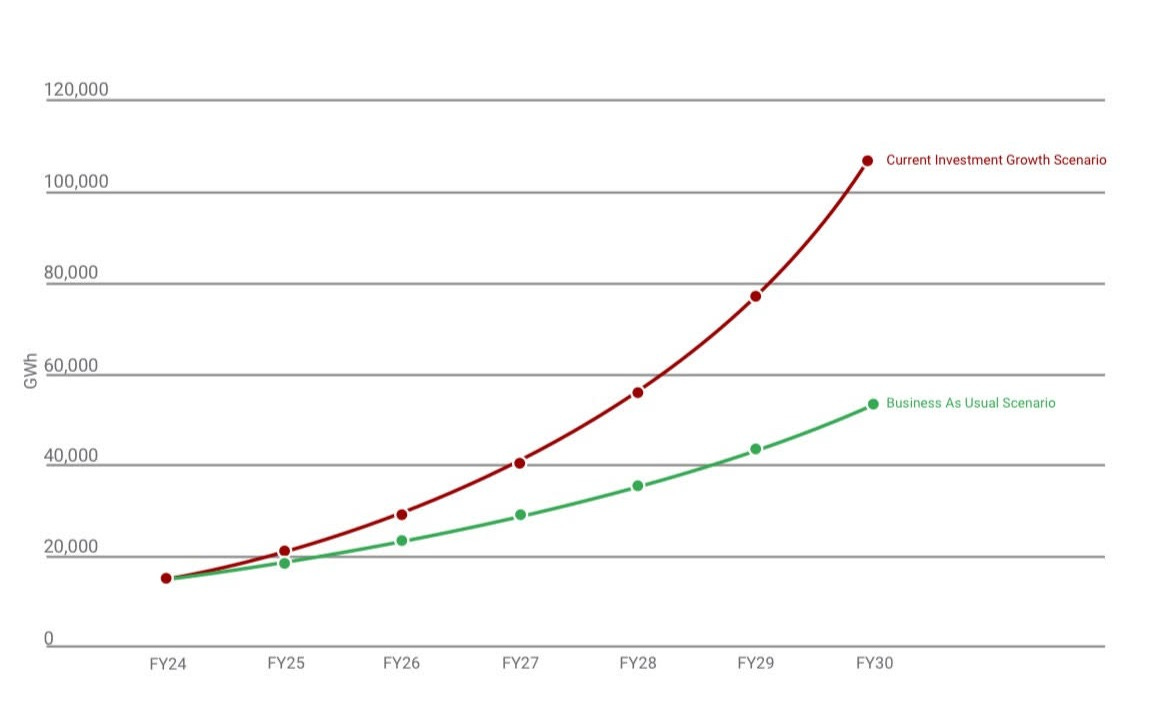
Microsoft’s projected North American energy needs through 2020, in gigawatt-hours of power. (That’s 1,000 megawatt-hours.) Image clipped from Stand.earth’s 2025 report on Microsoft’s AI footprint.
Why the sudden upward leap in Microsoft’s North American energy use, at least half of which is projected to come from the burning of fossil fuels, such as natural gas, that boost global temperature?
It’s not difficult to connect the dots. The day after Gates urged world leaders to downplay climate change as an issue of concern, Microsoft announced the company’s partnership with OpenAI dating back to 2019 had changed dramatically.
For one thing, OpenAI now has been unleashed in the for-profit realm, and Microsoft holds a 27 percent share currently worth about $135 billion. For another, the agreement allows Microsoft to work more independently on its own research into the next generation of AI: Artificial General Intelligence.
A research non-profit organization, Stand.earth, released a report in September about Microsoft’s plans for AI data centers in North America. As the graphic above illustrates, Microsoft’s AI energy needs will increase six-fold between last year and 2030—a mere five years from now.
The authors note the 2030 estimate topping a million megawatt-hours roughly totals the annual electricity consumption of the entire population of New England.
This projected leap fits with Microsoft’s own plans reported on its blog, minus details on energy use, and in Bloomberg. Also, NPR published last year Microsoft’s admission in a 2024 sustainability report that its energy use had grown by nearly a third since 2020 due to AI data center construction.
No wonder Bill Gates is throwing in the towel on climate change. Profits beckon.
There’s more to this story—and I’ll be sharing some of it during a Zoom talk tomorrow. Details of the talk are below, followed by some related reading from previous Eco-Logic posts about how AI is hampering efforts by our living planet to balance the extra heat from human industry.
Here’s the scoop on the talk from Hart Hagan, who will be hosting the webinar. For more details on this and other webinars in his Water and Climate series, check out his Substack publication and podcast, The Climate Report.
How are AI and data centers affecting our climate?
You’re invited to a free webinar on Wednesday, with my special guest, Melanie Lenart: How AI Impairs Our Planet’s Ability to Moderate Climate Change. Wednesday, November 12 at 12:00 PM (Eastern Time)
Our living planet, which some call Gaia, has evolved ways to respond to climate changes. Yet AI requires monumental amounts of copper mining, land and water, which threatens Gaia’s ability to moderate and adapt to our warming temperatures.
Our presenter is Melanie Lenart, Ph.D., author of Life in the Hothouse: How a Living Planet Survives Climate Change. The book interprets Gaia theory–which maintains Earth has some means for moderating and adapting to warming temperatures. Dr. Lenart highlights the crucial role of forests and rivers. An environmental scientist and journalist, she has been covering the expansion of Artificial Intelligence and how it impacts our living planet on her Substack publication, Eco-Logic.
Great work, Melanie. Afraid I'll miss your talk, but good luck.