
Insect Apocalypse prevention: How to help bring them back


About a decade ago, I found a drowned bug in my dogs’ water dish. I’m guessing it was a lacewing, as it was quite pretty.
So I decided to save it for a sister who used “found objects” to make jewelry. I laid it out upside down on a piece of paper inside my home so its wings would dry nicely.
The next morning it was gone.
That’s when I learned how well insects can resuscitate from drowning. So now, anytime I find one in a dish of dog water or a glass of wine, I quickly dish them out and set them somewhere to dry. They usually survive, even the ones who have likely been paddling water for hours.
In an era when drivers can motor across town or further without getting many—or sometimes even any—splattered bugs on their windshields, the life of almost every insect becomes precious.
So, helping individual bugs survive is something everyone interested can do to slow down the Insect Apocalypse, which I described last week.
Avoiding pesticide treatments of lawns, or even avoiding lawns altogether, is another thing individuals can do to help. And choosing to buy organic food can protect insects even as it potentially improves your own health.
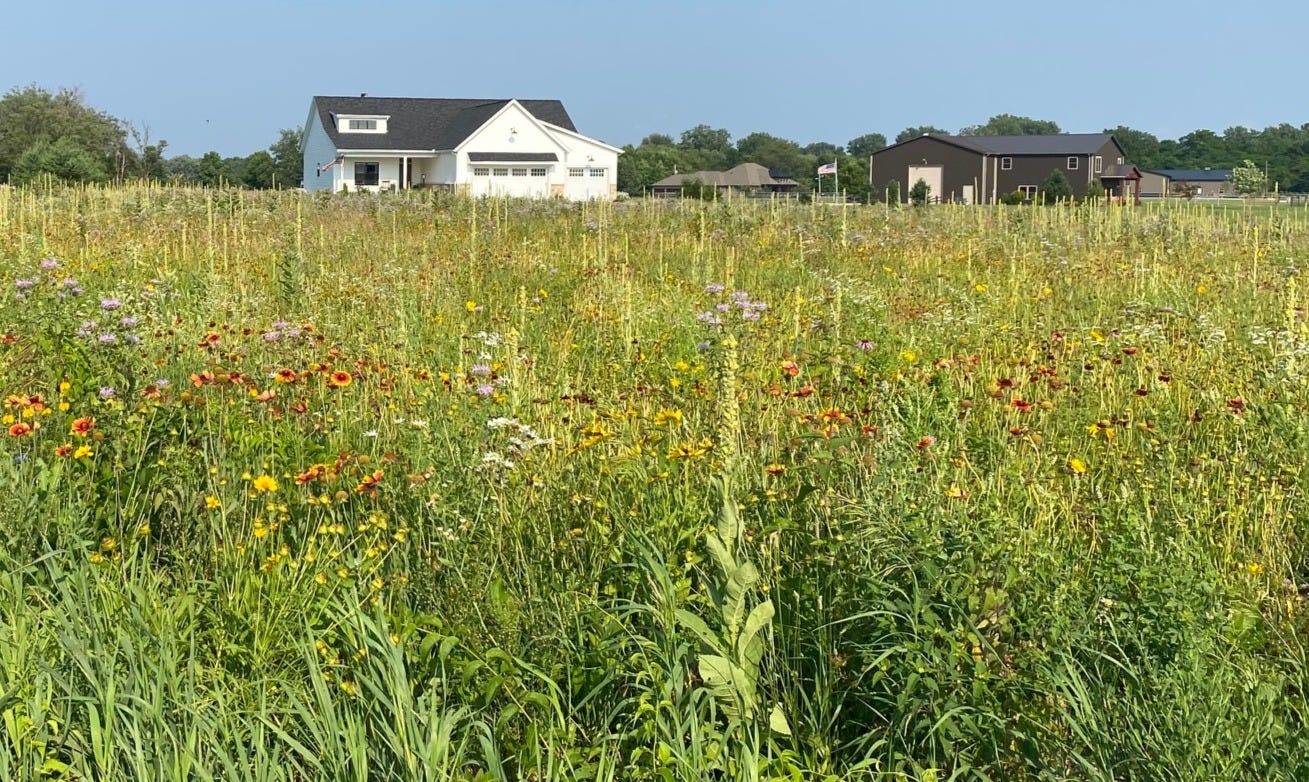
A front yard in northern Indiana. Photo by Melanie Lenart
Grow flowers instead of lawns
During the summer of 2021, my spouse and I spent a couple of months in northern Indiana helping my mom recover from a knee operation. In our explorations of the Warsaw area, we found small towns, big fields of corn and soy, and neatly trimmed lawns as far as the eye could see.
One day, we passed by a home with an expansive front yard filled with flowers. It looked like a pollinator paradise. Too bad it’s so rare.
Lawns actually take up more physical area than corn or soy or any of our most prolific crops, as researchers led by a NASA scientist reported in a white paper released in 2015. They estimated lawns of one kind or another sprawl across about 42 million acres in the United States.
Can you imagine what a different country we’d be living in if everybody grew flowers and prairies instead of lawns? Not only would we have more bugs, but we’d have more of the birds and other animals who eat bugs.

Instead, we not only mow down any grasses before they can produce the seeds that feed a variety of animals, but we also add herbicides to kill the “weeds” perceived as problematic.
Reports estimate Americans use 80 million pounds of pesticide a year for lawn care. The source, the Connecticut-based Environment and Human Health, Inc., cites a 1999 Environmental Protection Agency webpage that no longer exists. That amount has probably only increased, but it’s unlikely there will be an EPA update anytime soon from our current administration
“To me, the lawns have a special name,” said Brock Dolman of the California-based Occidental Arts & Ecology Center last week during a group Zoom session. “It’s Bobby Lawn.”

Growing natives
To avoid maintaining a lawn suitable for Babylon instead of Mother Nature, be careful to choose native species if you’re going to plant flowers. The National Wildlife Federation is a good source on how to create backyard wildlife habitats, and what species to plant to support butterflies.
Consult with your state’s Cooperative Extension professionals or local seed providers who focus on natives. I was surprised to learn from a friend who works on monarch butterflies that much of the milkweed sold commercially in Arizona actually doesn’t suit monarchs.
And while everyone loves butterflies, we have to be willing to accept caterpillars to get there.

As my friend Eric Eaton, author of the just released book Bugwatching: The Art, Joy and Importance of Observing Insects, advised in a text message, “Accept, or at least tolerate, ALL insects and spiders outdoors. The goal is a functional ecosystem, not your personal free-range zoo of your favorite creatures.”
Watering your native flowers and garden can help keep the area humid enough that insects don’t dry out, which they are quicker to do given higher modern temperatures. The presence of Wi-Fi and other electromagnetic fields also heats up insects, potentially causing them to dry up faster.
The extra moisture probably helps explain why some farms can serve as safe harbors for beneficial insects, as long as pesticide use is kept to a minimum or avoided completely.

Eating organic
Agriculture is seen as a major contributor to the insect decline for its destruction of natural habitat as well as its abundant use of insecticides and other toxins.
Conventional farms rely heavily on insect-killing poisons to keep crops free of pests. As I mentioned in Tuesday’s Eco-Logic post, the United States uses more pesticides than any country in the world.
As entomologist Vicki Hird noted, “Yes, some insects can be a big nuisance, but in many ways we have gone so far researching and working out how to kill a few that we’ve forgotten to protect the rest.”
When you buy organic food, it helps protect insects. To be certified as organic, growers must refrain from applying any chemical pesticides or even fertilizers. Integrated pest management also can dramatically reduce the use of pesticides.
Besides helping insects, supporting the farmers who avoid pesticides protects many creatures that eat insects. Birds are particularly sensitive to insecticides. It also protects the water serving animals of all kinds, including humans, from contamination.
Choosing organic food also protects your health, as it means you will consumer fewer toxic chemicals.
Buying organic even helps protect jobs. As Wilfrid Calvin, a University of Arizona Extension specialist, noted, organic growers rely more heavily on manual labor for weed and pest control.
Consumers can help, too, by being willing to wash their vegetables and accept the occasional hole in a piece of lettuce, Calvin said.
As it is, wholesale buyers known as shippers will visit a field and reject the crop if it appears too infested. Then the grower has little recourse but to plow the material back under as green manure.
“If we want to reduce the amount of insecticide being applied, the consumers need to play a role as a well,” he added. “There needs to be a trade-off.”

Watch out for light pollution
I started getting especially worried about the insect decline a few weeks ago when I noticed almost no bugs flocked to the light I use when working outside under my ramada. Well, our desert home outside Tucson received more than an inch of rain Tuesday. By last night, the light did attract some insects.
It was encouraging to see some bug life around. But I guess the absence of bugs for six weeks of summer has me feeling more protective of them than I had in previous years.
So I quickly turned it off and moved inside. Moths and other night flyers can get exhausted and neglect eating when entranced by light.
These individual changes won’t solve the problem, by any means. But if enough individuals practice them, it could add up.
As far as I’m concerned, every individual bug counts. That means every action to save one or more bugs also counts for something.
We’ve got to start somewhere.
I will come back to the topic of what we can do about electromagnetic fields, a.k.a. EMFs, once a pending scientific paper on policy is published in a month or so.
Light pollution is also hurting the birds 😞