
Targeting girls
The war on Iran in the context of International Women's Day, Oak Flat

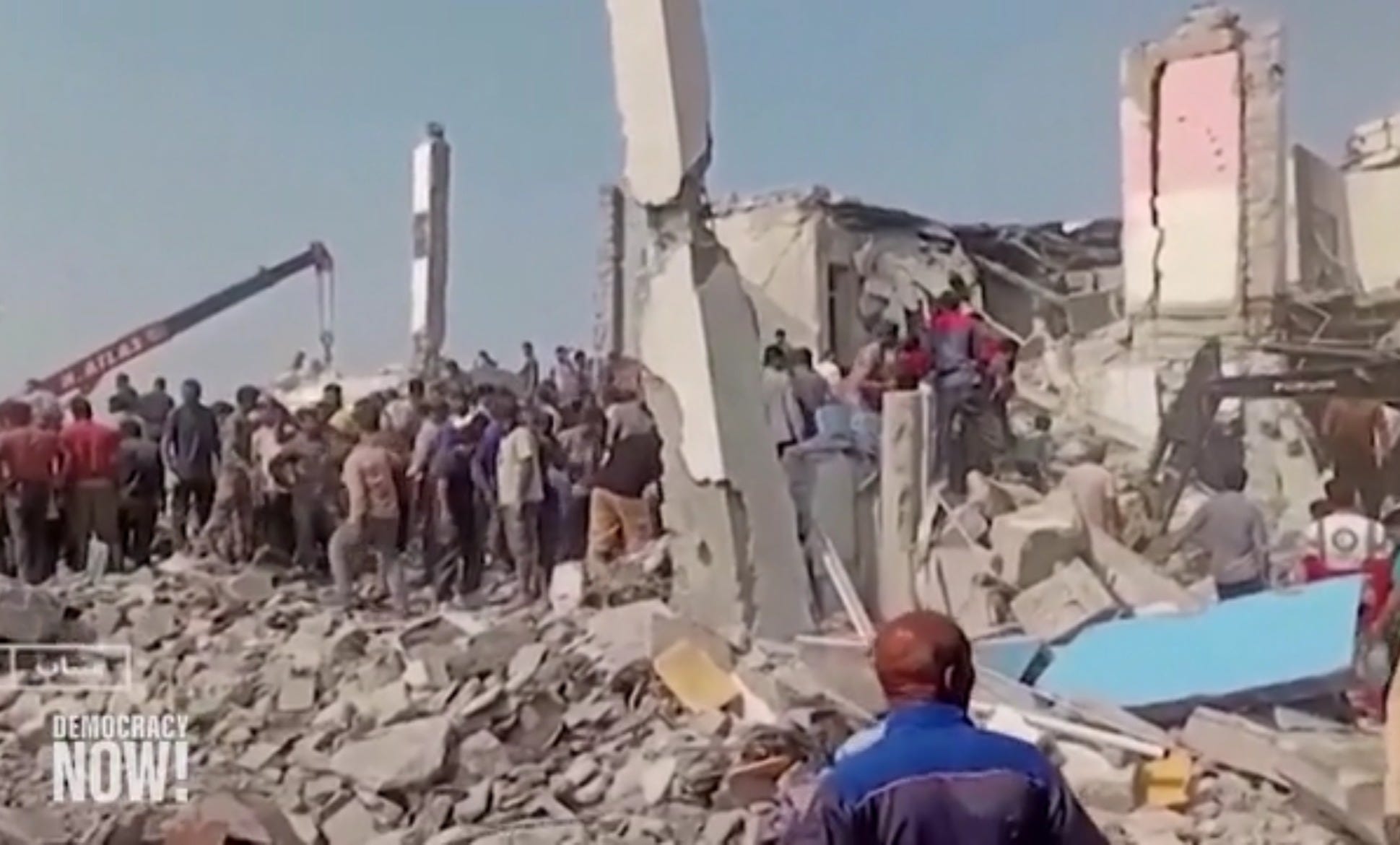
An estimated 165 schoolgirls died in the bombing of an Iranian school, shown here. Image clipped from Democracy Now report.
War is bad for children and other living things.
That saying, popular during the Vietnam War, comes to mind as I watch the images of bombs exploding in Iran at the hands of the United States of America, my homeland.
On International Women’s Day, please join me for a moment to honor the little girls and budding young women who died in the first wave of attacks last Saturday.
The bombs killed virtually all the young girls, ages 7 to 12, attending Shajarah Tayyebeh Elementary School in the southern Iranian town of Minab that day, the first day of the school week. That’s the loss of 165 girls.
Mothers, aunts, women—people of all genders—are you OK with this wartime slaughter of small girls?
Ponder that with your favorite female child in your mind—or, rather, in your heart.
For most of you, the answer is clear: No. That is Not OK. You are the ones I’m writing for today.
Further, I want to consider this cruel killing of girls in the context of another Trump-authorized move—namely, the proposed destruction of the Apache ceremonial grounds known in English as Oak Flat.
Whether deliberate or not, that Trump-approved action also would target young women.
How could we?
Let’s start with the ongoing investigation into how a girls’ school became a target in an undeclared war on Iran launched by US President Donald J. Trump and Israeli Prime Minister Benjamin Netanyahu.
A United Nations agency called the targeting of an active school a “grave violation” of international law. Even in warfare, nations are not supposed to kill civilians—especially not children.
While the US administration continues to claim our country wouldn’t intentionally target children, officials hedged questions about this elementary school in Minab with vague promises to investigate.
That’s not a denial. For this administration, that’s close to an admission.
Of course, the president later tried to accuse Iran of the bombing, even as Defense Secretary Pete Hegseth continued to acknowledge an investigation was underway.
The school was near a military site of Iran’s Islamic Revolutionary Guard Corps, but the building itself had been converted into a school for local children more than a decade ago. On March 3, the respected news organization Al Jazeera concluded:
Either US and Israeli forces relied, in striking the vicinity of the Asif Brigade, on a very old, outdated intelligence target bank (dating to before 2013), which would constitute grave negligence and reckless disregard for civilian lives; or the strike was carried out deliberately and with prior knowledge to inflict maximum societal shock and undermine popular support for Iran’s military establishment.
What’s more, these girls were targeted not once, but twice, according to on-the-scene reporting by the London-based Middle East Eye. Witnesses said scattered survivors of the blast on the elementary school were huddling in what they thought was a safe place when the second strike destroyed their remaining shelter.
Are you telling me today’s sophisticated drones couldn’t look through a window and see schoolgirls?
Not once, but twice?
Evidence points to US
In this age of sophisticated high tech, that seems hard to believe. As New York Times reporters Malachy Browne and Aaron Boxerman wrote on March 5:
But a body of evidence assembled by The New York Times — including newly released satellite imagery, social media posts and verified videos — indicates the school building was severely damaged by a precision strike that occurred at the same time as attacks on an adjacent naval base operated by the Islamic Revolutionary Guards Corps.
And official statements that U.S. forces were attacking naval targets near the Strait of Hormuz, where the I.R.G.C. base is located, suggest they were most likely to have carried out the strike.
In other words, the New York Times analysis suggests the United States is likely behind the strike on the girls’ school.
One father told a Middle East Eye reporter his daughter would talk about her plans to be a doctor. “You are already my little doctor,” he’d tell her. Another parent said his daughter would watch the news, then play-act her own planned future in newscasting.
These girls, some of them nearing the cusp of adulthood, were robbed of the chance to live the vibrant futures they imagined.
Planned destruction in Arizona
Even before he authorized the bombings tearing apart Minab, Tehran and other Middle East cities and the people who live there, President Donald J. Trump was eager to see the explosive destruction of Apache sacred land known in English as Oak Flat.
The sacred land in modern-day Arizona is tentatively slated to become a pile of rubble in a 1,000-foot deep hole, unless the courts intervene. (At least, there’s still hope the courts will intervene.)
Government-sanctioned plans call for copper mining done in a way that would devour a river and the land and even bedrock underlying oak groves in Tonto National Forest, near Phoenix. Underground blasts from a series of explosions would undermine the surface, causing it to collapse into an uninhabitable crater more than 1,000 feet deep and more than 2 miles in diameter.
The huge hole would defy even the pretense of future forest restoration.
No river, no forest, no ceremonies.
Nothing but a rubble-strewn chasm left of the ground considered sacred by the Apache and other tribal nations for countless centuries.
Why?
So foreign mining companies could mine the copper buried deep below. These companies from China, Australia and elsewhere go under the joint heading of Resolution Copper. Company officials argue they need to use the destructive approach involving underground explosions to save money.
This destruction also targets girls—in this case, the young Apache women whose arrival into adulthood culminates in four-day traditional ceremonies at the site.
Destruction versus Creation
Can we stop blowing holes in our Mother Earth?
Where Americans and our allies are reducing creation to rubble—whether from bombs falling in the undeclared war on Iran or from corporate bombs undermining sacred land with government permission—we are declaring war on our planet.
Destructive blasts, in all their forms, are not the path to a better, more livable world.
Yet it seems we have leadership that doesn’t envision a more livable world. As Naomi Klein and Astra Taylor wrote some months ago in the Guardian, this administration seems to actively seek a destructive end—namely, a destructive End Times.
If anything, the Trump administration’s clamoring for an End Times Armageddon has intensified since Klein and Taylor’s April piece.
By Monday of last week, the Military Religious Freedom Foundation had received more than 110 complaints from at least 30 military installations since the war started. Most complain commanders were invoking religious war in interactions with US troops. In one example shared in a March 2 Substack post by Jonathan Larsen:
A combat-unit commander told non-commissioned officers at a briefing Monday that the Iran war is part of God’s plan and that Pres. Donald Trump was “anointed by Jesus to light the signal fire in Iran to cause Armageddon and mark his return to Earth,” according to a complaint by a non-commissioned officer.
This Armageddon-fueled fantasy gets to the heart of our modern-day path toward destruction. Follow-up stories in The Nation and The Intercept support Larsen’s interpretation that US leaders are pursuing this push for destruction under an End Times scenario.
Extremists at the highest levels
The launching of an Armageddon suits evangelical understanding from the New Testament Book of Revelations of how Christ would be welcomed back into the world for a second time.
It’s a fundamentalist Christians stance that the rebirth of a being—Jesus Christ, who Christians agree initially came into the world through his mother’s womb—now requires the flames of Armageddon for a second coming.
Not all Christians accept this interpretation, of course. On Sunday, Catholic Pope Leo XIV asked people to pray for peace in the Middle East, connecting via #PrayTogether.
At least Congress has requested an investigation into the extent of the US military’s co-option by fundamentalists.
In a March 6 letter, members of the House Armed Services Subcommittee on Military Personnel wrote, “We must ensure that military operations are guided by facts and the law, not end-times prophecy and extreme religious beliefs.”
We’ve already lost 165 girls, and more than a thousand other Iranian people, in the first week of this war that remains undeclared and unexplained.
More bombing of oil refineries is causing an oil-tainted rain to fall in parts of Tehran, a city reportedly dealing today with fires under a pall of black smoke.
It’s more important than ever that we resist a paralysis that could prevent us from detouring away from the path we’re on. If we are to emerge from this administration with any real hope for the future, we must choose creation over destruction.
We must accept that sovereign nations are not subject to invasion, nor to the destruction of their cities and their land, nor to their sacred lands.
And we must stop this war on girls, this destroying of life on earth, and the destruction, in all its forms, of our planet.
This includes the world itself, as Mother Earth, Mother Nature, Gaia, Pachamama, Planet Earth, or whatever you want to call the planet and underlying ground that nurtures life with its rivers and forests.
As Klein and Taylor put it in their Guardian piece:
To have a hope of combating the end times fascists, with their ever-constricting and asphyxiating concentric circles of “ordered love”, we will need to build an unruly open-hearted movement of the Earth-loving faithful: faithful to this planet, its people, its creatures and to the possibility of a livable future for us all.
The girls in the town of Minab paid the highest price for what is looking like US extremism. Their families will grieve the loss of these girls—their daughters, granddaughters, friends, sisters—for generations to come.
I invite readers to honor them in your mind, perhaps with a moment of silence.
And I want to remind everyone the Apache Stronghold welcomes prayers and thoughts favoring the protection of Oak Flat, sacred land they know as Chi’chil Bildagoteel.
Only respect for life has any hope of getting us beyond this culture of death.
